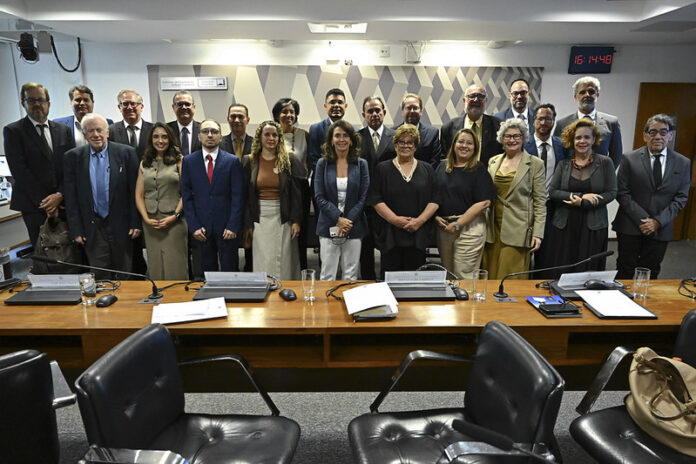
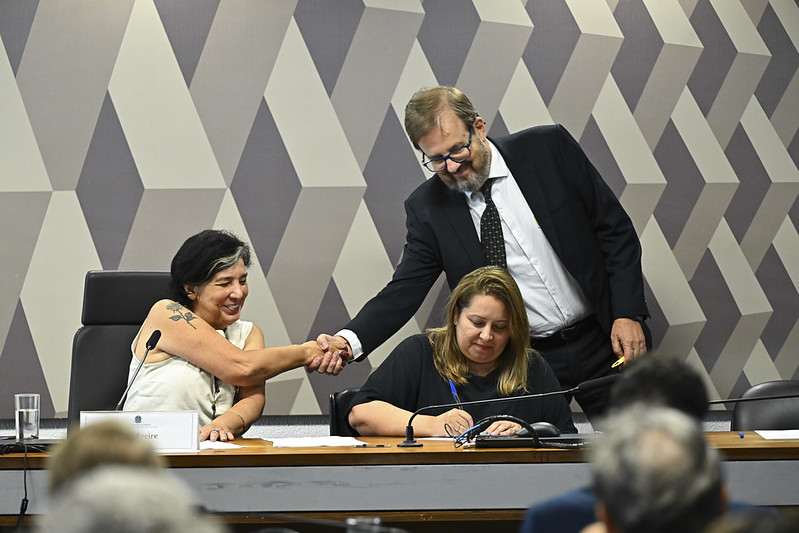
A Federação Nacional dos Jornalistas (FENAJ) passou a integrar oficialmente, nesta segunda-feira (9/2), a nova composição do Conselho de Comunicação Social do Congresso Nacional (CCS). A presidenta da FENAJ, Samira de Castro, tomou posse como conselheira titular representante dos jornalistas, tendo Paulo Zocchi como suplente. O mandato é de dois anos.
Foto: Jefferson Rudy/Agência Senado
A instalação do colegiado marca o início da 7ª composição do CCS, órgão previsto na Constituição Federal e responsável por assessorar o Congresso Nacional em temas estratégicos da comunicação social brasileira, como produção de pareceres, estudos e recomendações sobre projetos de lei e políticas públicas.
Para Samira de Castro, a presença da FENAJ no Conselho é fundamental em um momento de profundas transformações no mundo do trabalho e no ecossistema da comunicação. ““O CCS é um espaço estratégico para o debate público sobre comunicação e democracia. A presença da FENAJ garante que a voz das e dos jornalistas esteja no centro das discussões, especialmente diante da precarização do trabalho, da pejotização e das ameaças à profissão”, afirmou.
Samira destacou que a Federação atuará de forma firme no debate sobre a regulamentação da chamada Lei do Multídia, alertando para os riscos da flexibilização e da descaracterização da profissão. “Não podemos aceitar que novas tecnologias sejam usadas como pretexto para retirar direitos, fragilizar vínculos trabalhistas e substituir jornalistas por modelos precarizados. Jornalismo é profissão regulamentada e essencial à democracia”, reforçou.
O conselheiro suplente Paulo Zocchi ressaltou que o CCS terá papel central na construção de marcos regulatórios capazes de enfrentar os desafios impostos pelas plataformas digitais, pela inteligência artificial e pela crise de financiamento do jornalismo – tudo isso intrísecamente ligado ao tema da suberania nacional perante as chamadas big techs.
Foto: Jefferson Rudy/Agência Senado
“A concentração das plataformas, a exploração de conteúdo jornalístico sem remuneração justa e o uso indiscriminado de IA impactam diretamente a sustentabilidade do jornalismo e as condições de trabalho da categoria. Precisamos de regulação que proteja o interesse público e os trabalhadores”, afirmou.
Zocchi também enfatizou a necessidade de enfrentar a pejotização e outras formas de precarização que avançam no setor. “Fortalecer os direitos trabalhistas dos jornalistas é condição para garantir informação de qualidade à sociedade. Não existe jornalismo livre sem jornalistas com direitos”, disse.
A FENAJ acompanhará de perto os debates no Conselho, com prioridade para temas como a regulamentação das plataformas digitais, a regulação da inteligência artificial, a defesa do jornalismo profissional, a valorização do trabalho jornalístico e a sustentabilidade econômica do setor.
A posse reafirma o compromisso da Federação com a defesa da democracia, da liberdade de expressão e do direito da sociedade à informação de qualidade.
Mulheres eleitas para presidência e viceFoto: Jefferson Rudy/Agência Senado
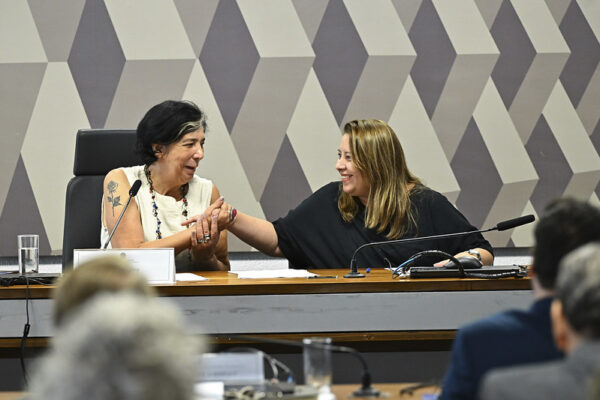
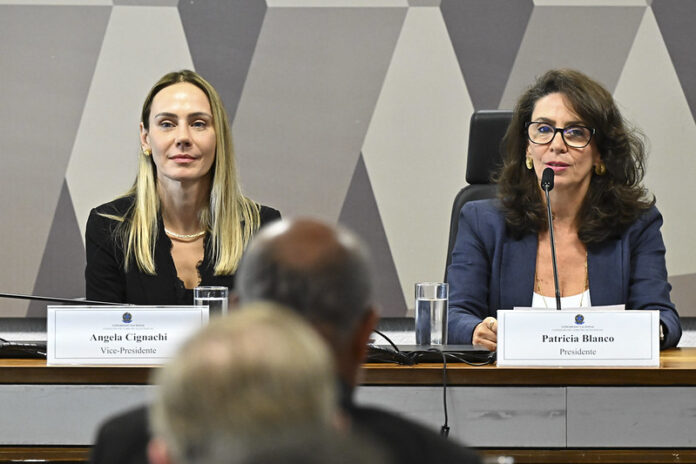
Pela primeira vez desde a sua criação, duas mulheres ocuparam os cargos de presidente e vice-presidente do CCS, sendo eleitas por aclamação. Patrícia Blanco é especialista em liberdade de expressão, comunicação e educação midiática. É bacharel em relações públicas, com pós-graduação em marketing, e atua nas áreas de comunicação e relações governamentais desde 1990. Foi vice-presidente do CCS na gestão anterior e atualmente é presidente executiva do Instituto Palavra Aberta, onde lidera iniciativas de combate à desinformação. Patrícia também integra a Comissão Permanente de Liberdade de Expressão do Conselho Nacional de Direitos Humanos e o Conselho de Ética do Conar.
“Estamos começando um mandato em um ano tão desafiador e complexo, com eleições gerais, no qual os temas relativos à comunicação social farão parte de um debate extremamente importante para a manutenção dos espaços democráticos, principalmente para a participação cidadã na política nacional, no ambiente de discussões e de liberdade de expressão”, afirmou Patrícia ao ser empossada.
Patrícia disse ainda que o CCS teve recorde de audiência da cidadania nas audiências públicas no mandato anterior, mostrando a importância do Conselho neste momento, com destaque para temas como fake news, uso de inteligência artificial, VOD e o debate sobre o futuro do audiovisual.
Angela Cignachi Baeta Neves é mestre em Função Social do Direito pelo Centro Universitário Alves Faria, pós-graduada em Direito Eleitoral pela Pontifícia Universidade Católica de Minas Gerais e bacharel em Direito pelo Centro Universitário de Brasília. Possui atuação no contencioso judicial e administrativo nas áreas do Direito Eleitoral e Direito Público, perante os Tribunais Superiores, com atuação constante em ações de controle concentrado e temas de repercussão geral em matéria tributária, junto ao Supremo Tribunal Federal (STF).
This mode enables people with epilepsy to use the website safely by eliminating the risk of seizures that result from flashing or blinking animations and risky color combinations.
Visually Impaired Mode
Improves website's visuals
This mode adjusts the website for the convenience of users with visual impairments such as Degrading Eyesight, Tunnel Vision, Cataract, Glaucoma, and others.
Cognitive Disability Mode
Helps to focus on specific content
This mode provides different assistive options to help users with cognitive impairments such as Dyslexia, Autism, CVA, and others, to focus on the essential elements of the website more easily.
ADHD Friendly Mode
Reduces distractions and improve focus
This mode helps users with ADHD and Neurodevelopmental disorders to read, browse, and focus on the main website elements more easily while significantly reducing distractions.
Blindness Mode
Allows using the site with your screen-reader
This mode configures the website to be compatible with screen-readers such as JAWS, NVDA, VoiceOver, and TalkBack. A screen-reader is software for blind users that is installed on a computer and smartphone, and websites must be compatible with it.
Online Dictionary
Readable Experience
Content Scaling
Default
Text Magnifier
Readable Font
Dyslexia Friendly
Highlight Titles
Highlight Links
Font Sizing
Default
Line Height
Default
Letter Spacing
Default
Left Aligned
Center Aligned
Right Aligned
Visually Pleasing Experience
Dark Contrast
Light Contrast
Monochrome
High Contrast
High Saturation
Low Saturation
Adjust Text Colors
Adjust Title Colors
Adjust Background Colors
Easy Orientation
Mute Sounds
Hide Images
Hide Emoji
Reading Guide
Stop Animations
Reading Mask
Highlight Hover
Highlight Focus
Big Dark Cursor
Big Light Cursor
Cognitive Reading
Virtual Keyboard
Navigation Keys
Accessibility Statement
sjsp.org.br
23 de outubro de 2026
Compliance status
We firmly believe that the internet should be available and accessible to anyone, and are committed to providing a website that is accessible to the widest possible audience,
regardless of circumstance and ability.
To fulfill this, we aim to adhere as strictly as possible to the World Wide Web Consortium’s (W3C) Web Content Accessibility Guidelines 2.1 (WCAG 2.1) at the AA level.
These guidelines explain how to make web content accessible to people with a wide array of disabilities. Complying with those guidelines helps us ensure that the website is accessible
to all people: blind people, people with motor impairments, visual impairment, cognitive disabilities, and more.
This website utilizes various technologies that are meant to make it as accessible as possible at all times. We utilize an accessibility interface that allows persons with specific
disabilities to adjust the website’s UI (user interface) and design it to their personal needs.
Additionally, the website utilizes an AI-based application that runs in the background and optimizes its accessibility level constantly. This application remediates the website’s HTML,
adapts Its functionality and behavior for screen-readers used by the blind users, and for keyboard functions used by individuals with motor impairments.
If you’ve found a malfunction or have ideas for improvement, we’ll be happy to hear from you. You can reach out to the website’s operators by using the following email
Screen-reader and keyboard navigation
Our website implements the ARIA attributes (Accessible Rich Internet Applications) technique, alongside various different behavioral changes, to ensure blind users visiting with
screen-readers are able to read, comprehend, and enjoy the website’s functions. As soon as a user with a screen-reader enters your site, they immediately receive
a prompt to enter the Screen-Reader Profile so they can browse and operate your site effectively. Here’s how our website covers some of the most important screen-reader requirements,
alongside console screenshots of code examples:
Screen-reader optimization: we run a background process that learns the website’s components from top to bottom, to ensure ongoing compliance even when updating the website.
In this process, we provide screen-readers with meaningful data using the ARIA set of attributes. For example, we provide accurate form labels;
descriptions for actionable icons (social media icons, search icons, cart icons, etc.); validation guidance for form inputs; element roles such as buttons, menus, modal dialogues (popups),
and others. Additionally, the background process scans all the website’s images and provides an accurate and meaningful image-object-recognition-based description as an ALT (alternate text) tag
for images that are not described. It will also extract texts that are embedded within the image, using an OCR (optical character recognition) technology.
To turn on screen-reader adjustments at any time, users need only to press the Alt+1 keyboard combination. Screen-reader users also get automatic announcements to turn the Screen-reader mode on
as soon as they enter the website.
These adjustments are compatible with all popular screen readers, including JAWS and NVDA.
Keyboard navigation optimization: The background process also adjusts the website’s HTML, and adds various behaviors using JavaScript code to make the website operable by the keyboard. This includes the ability to navigate the website using the Tab and Shift+Tab keys, operate dropdowns with the arrow keys, close them with Esc, trigger buttons and links using the Enter key, navigate between radio and checkbox elements using the arrow keys, and fill them in with the Spacebar or Enter key.Additionally, keyboard users will find quick-navigation and content-skip menus, available at any time by clicking Alt+1, or as the first elements of the site while navigating with the keyboard. The background process also handles triggered popups by moving the keyboard focus towards them as soon as they appear, and not allow the focus drift outside it.
Users can also use shortcuts such as “M” (menus), “H” (headings), “F” (forms), “B” (buttons), and “G” (graphics) to jump to specific elements.
Disability profiles supported in our website
Epilepsy Safe Mode: this profile enables people with epilepsy to use the website safely by eliminating the risk of seizures that result from flashing or blinking animations and risky color combinations.
Visually Impaired Mode: this mode adjusts the website for the convenience of users with visual impairments such as Degrading Eyesight, Tunnel Vision, Cataract, Glaucoma, and others.
Cognitive Disability Mode: this mode provides different assistive options to help users with cognitive impairments such as Dyslexia, Autism, CVA, and others, to focus on the essential elements of the website more easily.
ADHD Friendly Mode: this mode helps users with ADHD and Neurodevelopmental disorders to read, browse, and focus on the main website elements more easily while significantly reducing distractions.
Blindness Mode: this mode configures the website to be compatible with screen-readers such as JAWS, NVDA, VoiceOver, and TalkBack. A screen-reader is software for blind users that is installed on a computer and smartphone, and websites must be compatible with it.
Keyboard Navigation Profile (Motor-Impaired): this profile enables motor-impaired persons to operate the website using the keyboard Tab, Shift+Tab, and the Enter keys. Users can also use shortcuts such as “M” (menus), “H” (headings), “F” (forms), “B” (buttons), and “G” (graphics) to jump to specific elements.
Additional UI, design, and readability adjustments
Font adjustments – users, can increase and decrease its size, change its family (type), adjust the spacing, alignment, line height, and more.
Color adjustments – users can select various color contrast profiles such as light, dark, inverted, and monochrome. Additionally, users can swap color schemes of titles, texts, and backgrounds, with over seven different coloring options.
Animations – person with epilepsy can stop all running animations with the click of a button. Animations controlled by the interface include videos, GIFs, and CSS flashing transitions.
Content highlighting – users can choose to emphasize important elements such as links and titles. They can also choose to highlight focused or hovered elements only.
Audio muting – users with hearing devices may experience headaches or other issues due to automatic audio playing. This option lets users mute the entire website instantly.
Cognitive disorders – we utilize a search engine that is linked to Wikipedia and Wiktionary, allowing people with cognitive disorders to decipher meanings of phrases, initials, slang, and others.
Additional functions – we provide users the option to change cursor color and size, use a printing mode, enable a virtual keyboard, and many other functions.
Browser and assistive technology compatibility
We aim to support the widest array of browsers and assistive technologies as possible, so our users can choose the best fitting tools for them, with as few limitations as possible. Therefore, we have worked very hard to be able to support all major systems that comprise over 95% of the user market share including Google Chrome, Mozilla Firefox, Apple Safari, Opera and Microsoft Edge, JAWS and NVDA (screen readers).
Notes, comments, and feedback
Despite our very best efforts to allow anybody to adjust the website to their needs. There may still be pages or sections that are not fully accessible, are in the process of becoming accessible, or are lacking an adequate technological solution to make them accessible. Still, we are continually improving our accessibility, adding, updating and improving its options and features, and developing and adopting new technologies. All this is meant to reach the optimal level of accessibility, following technological advancements. For any assistance, please reach out to